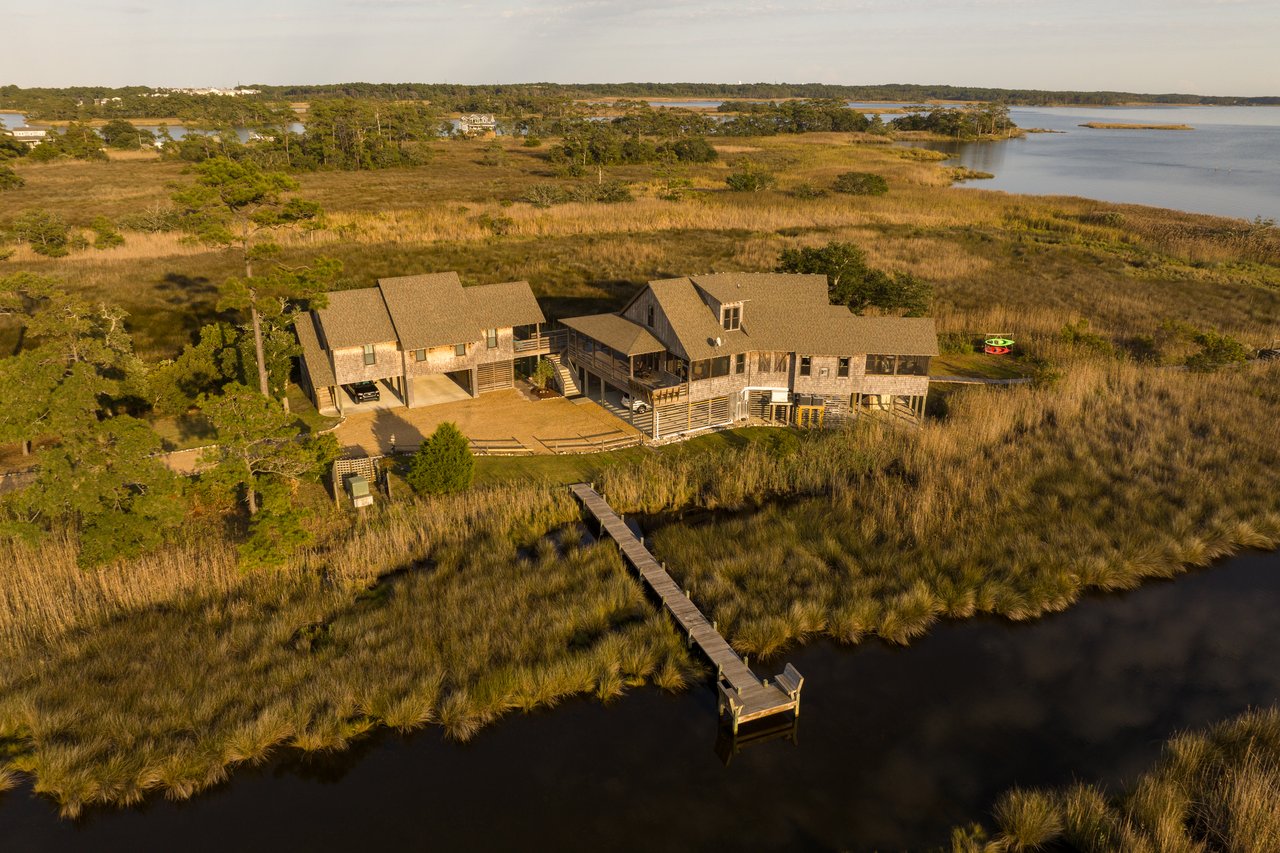
Dews Island sits in the Currituck Sound, just west of the Corolla Wild Horse Fund's farm in Grandy. In the late 1990s, after the horse fence went up on the north beach, a group of Banker horses kept getting around it and wandering the paved parts of Corolla. In 1999 they were rounded up and moved to that island. Their colts were adopted out, and the mares stayed on the island until 2017, when the Fund was asked to remove them. Buttercup, Jasmine and Little Star, all from that group, now live on the farm across the water.
The farm only opens its gate to the public during open houses, so visits are rare. The next one is the Fund's annual Fall Open House on Saturday, Nov. 7, from 9 a.m. to 1 p.m. If you go, know this first. Almost every horse you'll meet in Grandy is there because the wild herd and people collided somewhere, through a fence, a handout or a boundary line. On the farm you can see each of those collisions one horse at a time.
A Farm Built for Horses That Can't Return
The Fund leased the Betsy Dowdy Equine Center, a 31-acre property in Grandy, starting in 2014. It bought the farm in 2018, when it housed 17 rescued horses. CWHF says the farm now houses more than 20 Bankers. The Fund treats removal from the wild as a last resort, saved for horses that are badly injured, sick or habituated to people. Every horse it removes gets a permanent home on the farm. Some heal and go into the adoption program, and others stay for life. Once a horse leaves the beach, it can't go back, because of the risk of exposing the herd to disease and because of the habituation problem.
Horses arrive on the farm, but none go back to the herd. Each resident's profile says why the horse came off the beach, and taken together the profiles show where the herd's real pressures come from.
| Horse | Left the wild | Why |
|---|---|---|
| Buttercup, Jasmine, Little Star | November 2017 | Remaining mares on Dews Island, where horses that circumvented the fence were moved in 1999 |
| Bonita, Kitty Hawk | May 2018 | "Renegade Six" harem that kept crossing into Virginia |
| Arrow, Valentine | December 2021 | Extreme habituation and aggression from being fed by people |
| Riptide | August 2020 | Pythiosis in a leg cut |
| June | September 2022 | Pythiosis near the top of a hoof |
| Blossom | October 2023 | Severely torn ligament at roughly age 32 |
Louie came off the beach in the early 2000s, back when colts were removed and adopted out to manage the herd's size. The Fund now uses non-hormonal contraception, and his profile calls him one of the few horses on the farm not removed because of illness, injury or habituation.
The Fence's Other End
The Dews Island horses got around the fence on the Corolla side. Bonita and Kitty Hawk came from the other end. They belonged to a harem the Fund calls the "Renegade Six," which kept slipping around the north fence into Virginia's False Cape State Park. The ground there is marsh, and the horses were crossing navigable water, so the fence couldn't be extended. After repeated tries at moving the horses back to North Carolina, federal officials declared them "nuisances" and asked the Fund to bring them to the farm. The Fund called the loss of six healthy horses from the wild herd "devastating."
Kitty Hawk carries some of the herd's history with her. She qualifies as a daughter of Topnotch, a stallion whose sire Croatoan was prolific. One of her colts is still living in the wild.
The Removals People Caused Directly
The fence removals came from geography. The next group came from people's behavior. Arrow and his mare Valentine were removed in December 2021 because of extreme habituation and aggression caused by people feeding them. The Fund says it tried to correct both the horses' behavior and the behavior of the people who approached them before removing them.
The two have turned out differently on the farm. Valentine has been rehabilitated, no longer shows food aggression, and is being trained under saddle. Arrow, born in 1998, is "always first at the gate for attention." His food aggression and reactive behavior "is something that will never change," and his job now is to show visitors why the wild horses must never be fed.
Topnotch was the most recent of these cases. The stallion came to the farm in November 2025 after becoming habituated. Meg Puckett, the Fund's Director of Herd Management, explained the term to Public Radio East this spring:
"And that's when a horse just becomes so used to, so desensitized to people, to being approached by people, to being touched by people, that there's no fear anymore. And so, they're not moving away from people. And then they also may begin to approach people. And that's when things get really dangerous."
The Fund cared for Topnotch for about nine months. In late July he developed acute colic and was euthanized, the Fund announced in a statement published by The Outer Banks Voice. He was in his 30s, well past the usual lifespan of a wild stallion. He had kept a large harem for most of his adult life, then lost his mares to a younger rival several years ago and lived as a bachelor until his relocation.
Feeding can also kill a horse outright. In 2020 a yearling colt in Corolla choked to death after someone fed it an apple, and an earlier foal died after being fed a watermelon rind. The open house rules carry the same warning: please do not bring apples, carrots or other treats for the horses.
The Removals Nobody Caused
Some removals had nothing to do with people. Riptide was rescued as a yearling after pythiosis set into a cut on his leg. Most cuts heal on their own in the wild, but pythiosis can be fatal and won't. He had surgery at NC State, recovered fully, and is now the Fund's best education ambassador. At 14 hands, he is one of the biggest Banker horses from Corolla. June went to NC State with the same infection in September 2022 and spent several weeks there in critical condition. She is now training to become an outreach ambassador.
June's mother, Blossom, was one of the oldest horses in the wild herd. A resident called in when she couldn't put weight on a front leg, and the vet found a severely torn ligament. She will always walk with a slight limp, and she will live on the farm for the rest of her life.
Riptide's sire, Surfer, stayed wild his whole life. In mid-June the roughly 15-year-old stallion died from a kick to the head, with injuries consistent with a kick from another horse. DNA testing had identified three of his offspring, one of them Riptide. Riptide now shares a field in Grandy with Porter and Louie.
Horses That Came Home
Living out a whole life on the farm doesn't always mean arriving there straight from the beach. Maria came off the beach in 2012 with a lame hind leg. Carlos was orphaned in 2013 at three weeks old, and Maria became his surrogate mother at the farm. A family in Tennessee adopted the pair together, and they lived there for more than a decade. The family later decided the horses would be better off back with CWHF, and they returned to North Carolina in spring 2026 to spend the rest of their lives on the farm. The Fund describes Carlos as a "Houdini" who can open gates, doors and windows that aren't securely latched. Dewey and Dudley, brothers born on Dews Island, also came back after years with a local family.
Before You Drive to Young Rider Lane
The open house is at the farm, 102 Young Rider Lane, Grandy. Two free screenings of The Secret of Corolla, a 32-minute documentary about the Bankers and island life, run at 10 a.m. and 11 a.m., each followed by a Q&A with staff. The farmhouse gift shop sells shirts and hats, and you can sponsor any horse you meet. A digital sponsorship includes a photo, a certificate, the horse's story and video updates.
- Suggested donation of $10 per vehicle at the gate
- Gates close 15 minutes before the 1 p.m. end time
- No outside food, and no horse treats of any kind
- No outside dogs, and dogs may not be left in vehicles; leashed service dogs are welcome
- The speed limit on the property is 5 mph
- Closed-toe shoes are recommended because of mud, biting insects and manure
- The event runs rain or shine but closes for lightning, so check the event page or call before you leave
The Fund doesn't say in advance which horses will be in view during the walking tour, only that visitors will meet the rescued Bankers currently in its care.
Currituck Bulls and BBQ is the same Saturday at the Currituck County Rural Center in Powells Point, but its page lists rodeo and BBQ tickets as sold out.
The Herd the Farm Exists to Protect
CWHF put the wild herd at approximately 115 horses as of July 2026, roaming close to 8,000 acres of beach, marsh and maritime forest along an 11-mile stretch. The Fund calls the herd "in excellent health and reproducing naturally," and says its biggest challenges are the effects of human encroachment. In July, The Assembly reported that the state budget Gov. Josh Stein signed includes $1 million for the Fund's breed conservation and habitat preservation work.
On the beach, North Carolina makes it illegal to come within 50 feet of the wild horses, according to Public Radio East. In Grandy, Arrow, the stallion people fed on the beach, is usually the first horse at the gate.
At Shane Collins The Obx Island Guys Team, we grew up with these horses north of the pavement, and we know what owning or renting in Carova means when the herd shares the neighborhood: gates, fences and rules about how you treat the horses. If you're weighing a property in the 4x4 area and want a direct conversation about living alongside the Bankers, Work With Us.