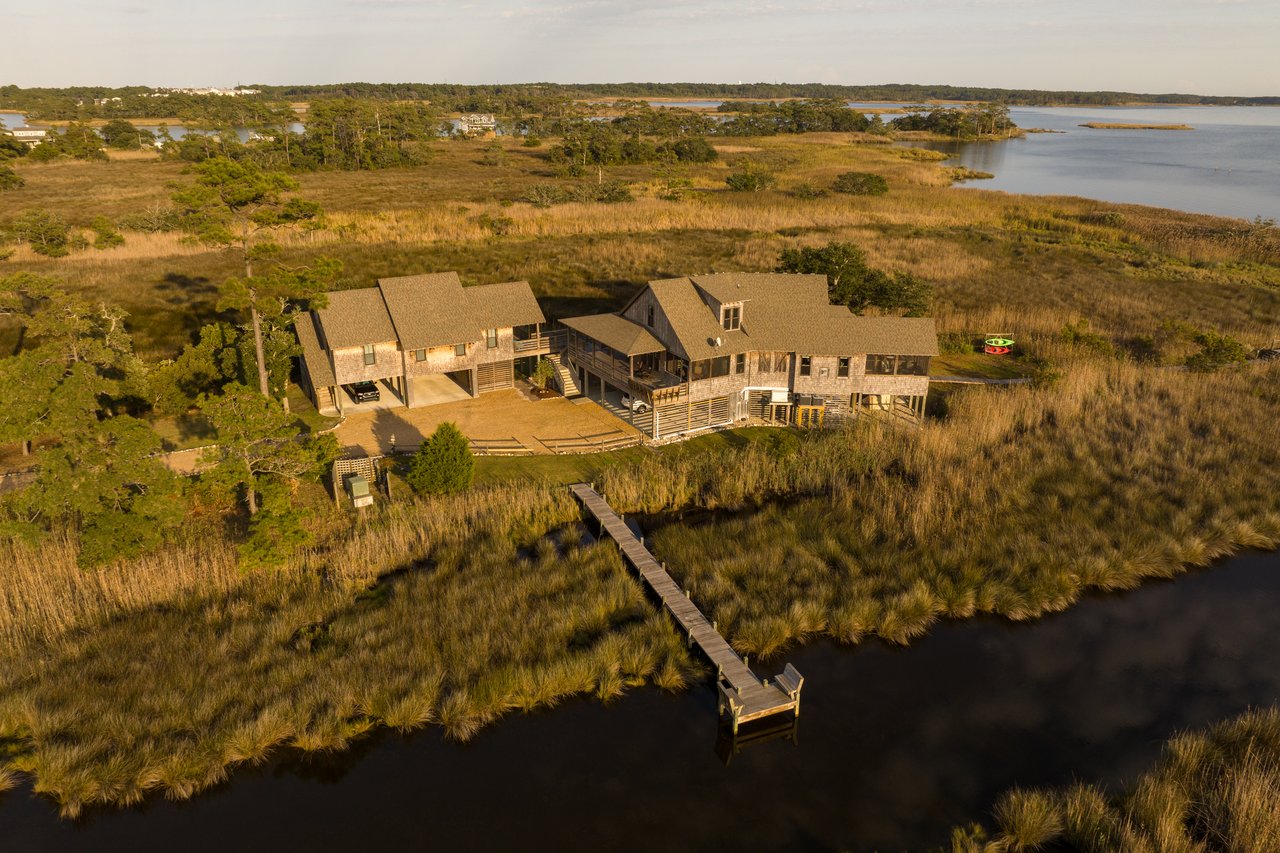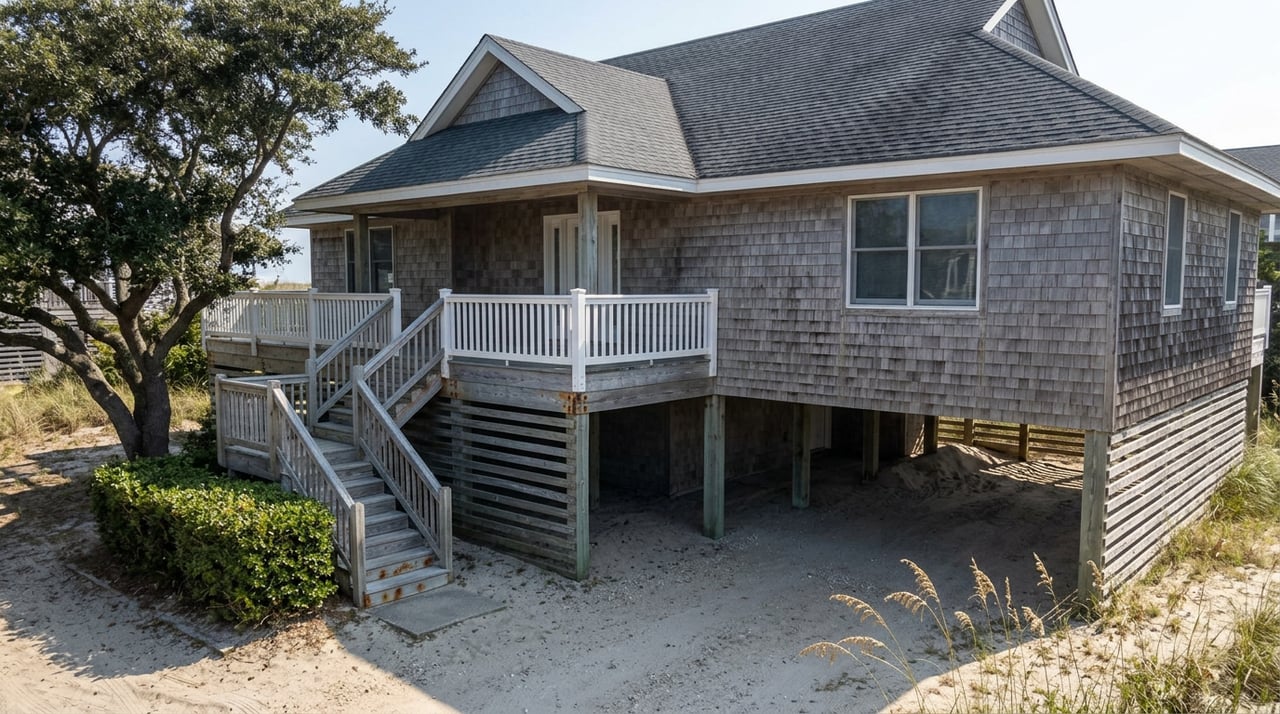
"Because short term returns on investment are generally so much higher than long-term, we must be very proactive about encouraging deed restrictions." That's Kill Devil Hills Mayor Ben Sproul, describing a problem most buyers never think to ask about until after closing: in this town, two houses at the same price, a few blocks apart, can have completely different answers to the question "can I rent this by the week?"
Kill Devil Hills gets shopped the way most Outer Banks towns get shopped, by median price and square footage. That number tells you almost nothing about what the property is actually allowed to do. The real variable is geography relative to a four-lane road, and the town has spent the last few years writing ordinances specifically because that geography has become an economic fault line.
The Bypass Is a Zoning Line, Not Just a Traffic Pattern
US 158, known locally as the Beach Bypass, splits Kill Devil Hills into markets that behave nothing alike.
East of Beach Road, oceanfront and oceanside lots sit in what amounts to the town's highest-and-best-use zone for vacation rentals. These are the houses built to be rented, on pilings, with minimal friction standing between an owner and a short-term rental permit.
Between Beach Road and the Bypass, the classic beach cottage stock still leans heavily toward short-term rental, but it shares blocks with a mix of primary residences, so the regulatory posture is a step more conservative.
West of the Bypass, the zoning tilts back toward year-round residential. Short-term rentals still happen here, particularly on soundfront lots, but the town treats this side of the highway as a neighborhood to protect rather than an income property to permit.
Keep going west and you reach Colington Island, annexed into the town decades ago, where the housing stock is almost entirely long-term and short-term rental opportunity is genuinely limited.
None of this shows up in a listing photo. It shows up in the zoning code, and a buyer who assumes rental performance from price alone is guessing.
Why the Middle of Town Belongs to Gas Stations
The commercial strip running down the Bypass corridor has a nickname locals still use: French Fry Alley. Kill Devil Hills Planning Director Meredith Guns explained the origin plainly. Decades ago, the founding towns of Kill Devil Hills, Nags Head, and Kitty Hawk agreed that Kill Devil Hills, sitting in the middle, would absorb the commercial development the other two didn't want on their own beach roads. That decision is why the Wawa on the Bypass sits on land that was zoned commercial before the first house went up in the neighborhood around it, a property right the town can't simply revoke because a new neighbor would prefer a different view.
The same conversation surfaced something that has nothing to do with restaurants and everything to do with rental capacity. Guns confirmed the state building code, not town policy, is what actually limits house size in Kill Devil Hills, and that the town's unusually deep lots, some running 30,000 to 40,000 square feet, are why the ceiling keeps climbing anyway. As of her 2024 interview, she pointed to a 28-bedroom house already built in town, with a 32-bedroom project under review at the time. A lot that size, in the right zone, isn't competing with a starter home down the street. It's competing with a small hotel.
The Ordinance Built to Fight the Math
Every dollar of that math points the same direction: short-term rental income beats long-term rental income, which means the market has no natural incentive to build anything but vacation houses. Kill Devil Hills responded by legislating against its own math.
The county laid the groundwork in 2018 with an ordinance permitting Cluster Home Developments, defined as more than one dwelling on a single parcel, deed-restricted to occupancy of 31 days or longer. Kill Devil Hills adopted its own version in January 2022 and sweetened the incentive by raising the allowable floor area ratio to between .55 and .6, with setbacks between units cut to two feet, making the density math pencil out for builders willing to accept the long-term-only deed restriction.
The ordinance got its real test in 2024, when builder Eddie Goodrich requested a special-use permit for a 21-home cluster project on seven adjoined lots between Martin Street and Boundary Street, near milepost 9 on the west side of the Bypass. Sproul defended the project as the product of "a creative incentive structure" designed to produce two- and three-bedroom homes he said had been almost absent from new construction in Kill Devil Hills for decades. The project drew more than 115 comments in local online discussion, most of them opposed, and the June 2024 hearing at Town Hall filled every seat. Town staff reminded the board that the proceeding was quasi-judicial, meaning members could weigh only a narrow set of factors defined by state law rather than general neighborhood opposition.
The lesson for a buyer isn't about that specific project. It's that the town is actively engineering exceptions to its own rental geography, which means the zoning map you check today may not describe every parcel forever, especially on the west side where these density deals get made.
What to Check Before You Assume Anything About Rental Rights
A price per square foot tells you what the market paid. It tells you nothing about what the property is permitted to earn. Before comparing two Kill Devil Hills listings on price alone, a buyer scrolling MLS sheets near Avalon Fishing Pier or out toward Colington should be asking a narrower set of questions:
- Which side of the Bypass is the parcel on, and is that documented in the zoning designation rather than assumed from the street address
- Is the lot in the Ocean Impact Residential zone, where setback and site rules were written around active rental use, or in a Low or High Density Residential zone written around permanent occupancy
- If the property is new construction on a subdivided lot west of the Bypass, does it carry a cluster-home deed restriction limiting stays to 31 days or more
- Has the parcel's zoning designation changed recently, given how often the town amends chapter 153 of its code
None of these questions show up on a comparable sales sheet. They show up in the town's own zoning records, and the answer changes what the house is actually worth to an investor versus what it's worth to a family looking for a primary residence.
The Takeaway for Anyone Comparing Kill Devil Hills to Its Neighbors
Kill Devil Hills gets described as the Outer Banks' centrally located, reasonably priced option, and that's true as far as it goes. What that framing leaves out is that the town isn't one market wearing one price tag. It's four rental geographies stacked on top of each other, governed by a zoning code the town keeps actively rewriting to correct its own incentive structure. A buyer who treats the whole town as interchangeable is pricing risk incorrectly in both directions, overpaying for rental potential on the west side, or underpaying for a truly unrestricted oceanside parcel because the listing didn't spell out the difference.
Frequently Asked Questions
Does a property's zoning district show up in a standard listing? Not reliably. Zoning designation and any deed restrictions tied to cluster-home developments live in county and town records, not in the MLS description, so they need to be pulled separately before an offer goes in.
Can a long-term-only cluster home ever convert to short-term rental later? The deed restriction is the mechanism the town uses to guarantee long-term occupancy, so a buyer should read that restriction directly rather than assume it can be renegotiated after purchase.
Is Colington a bad investment because of limited short-term rental options? Not necessarily, it simply serves a different buyer. Colington functions as a long-term residential market, which suits a primary-residence purchase or a buy-and-hold long-term rental strategy better than a weekly vacation rental play.
Rental geography like this is exactly the kind of detail that separates a comparable-sales printout from an actual investment decision. If you're weighing a Kill Devil Hills property against options elsewhere on the Outer Banks, Shane Collins and The OBX Island Guys Team can walk the zoning map with you before you write an offer, not after.