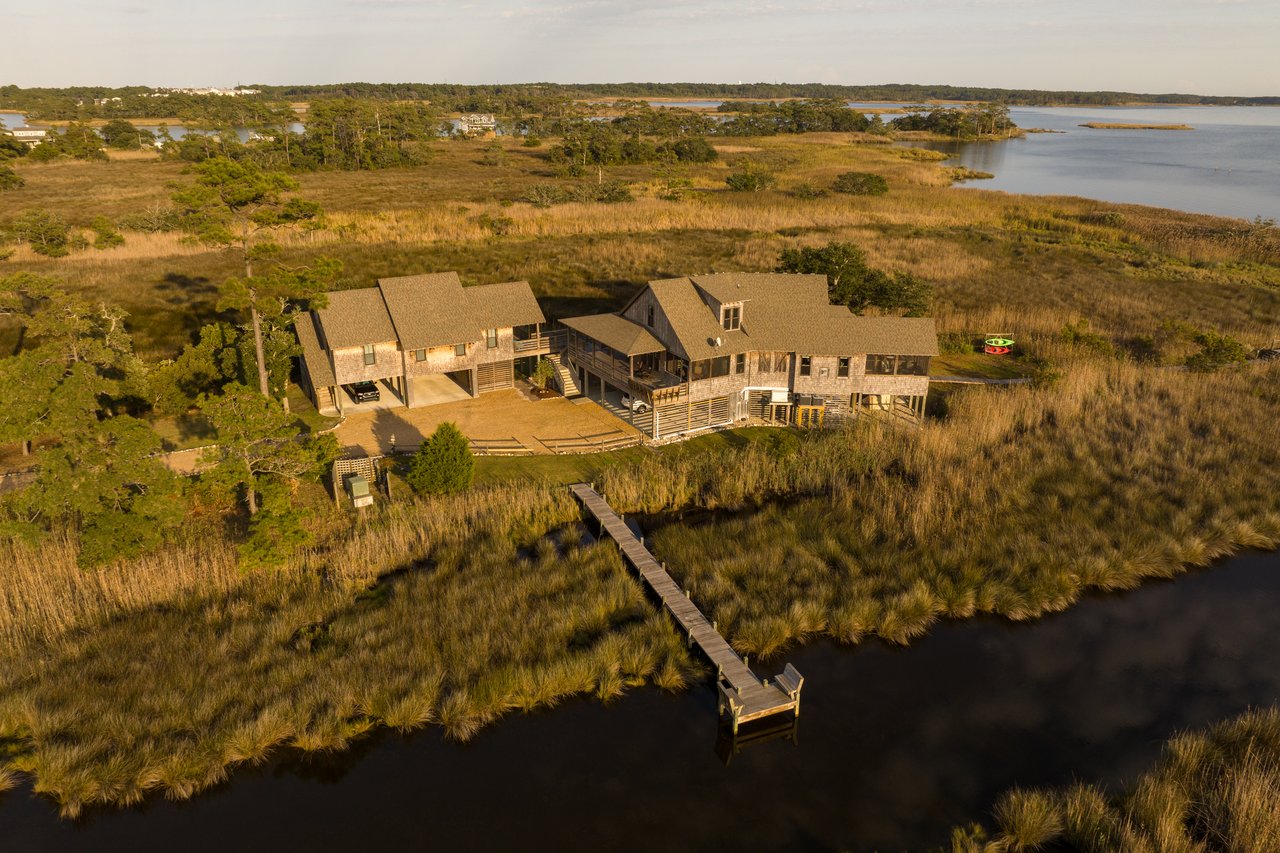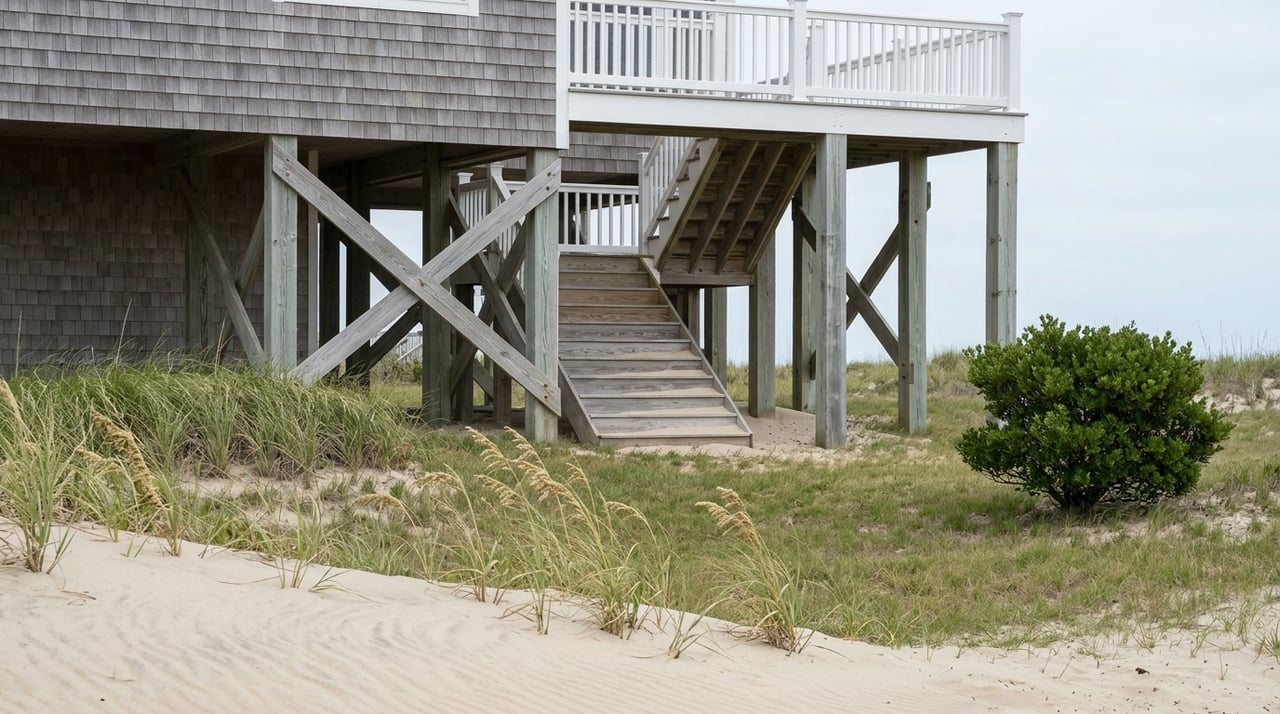
A buyer finds a lot on Sandpiper Road in Carova Beach. A Homes.com listing calls out an X flood zone, no mandatory flood insurance required by lenders, and a price tag well under what similar acreage costs three miles south in paved Corolla. The buyer calls a lender to discuss financing. The Mortgage Research article explains that appraisal guidelines require the property to be accessible year-round by vehicle. In Carova, the only road is the beach, and at a full-moon king tide it can narrow to nothing.
That access requirement is one practical part of buying in Corolla's 4x4 beaches. It is not the sand, and it is not the horses. It is how conventional and FHA underwriting actually works.
The Zone Nobody Expects
Corolla's paved oceanfront, the stretch most buyers picture first, often sits in mapped V or VE zones, the high-risk coastal categories where storm wave action is part of the calculation. Head north past where NC-12 ends, into Swan Beach, North Swan Beach, and Carova, and the pattern frequently flips. Listings there routinely advertise X or Shaded-X flood zone status, the designation that removes the mandatory purchase requirement entirely.
The reason isn't luck. It's elevation. Natural dune ridges in parts of the 4x4 area sit high enough above the base flood elevation that FEMA's maps classify them as lower risk than the paved village a few miles south, even though Carova is objectively closer to open ocean and further from any emergency response.
Here's the catch worth knowing before you fall in love with an "X zone, no insurance required" listing: FEMA says Risk Rating 2.0 was fully phased in by April 2023, and the Congressional Research Service explains that flood zones are no longer used to calculate a property's premium if you choose to buy a policy. The zone still determines whether a lender can force you to carry it. It no longer determines the premium. So an X zone lot can still make sense financially, but the zone alone does not establish the cost of a policy. And several Carova listings base their elevation claims on Google Earth Pro estimates the listing agent explicitly flags as unverified, telling buyers to confirm with a survey before assuming anything about buildability or flood status.
What Makes a Loan Officer Say No
According to OBX Maps, the beach that runs through the 4x4 area is legally a public road, which is a detail that matters because it rules out one common financing headache. Private road maintenance agreements—the paperwork neighbors sign to share the cost of grading a shared dirt road—can be a financing consideration. Carova doesn't have that problem, since the route is public.
What it has instead is a tougher standard to meet. Federal appraisal guidelines for both FHA and conventional loans require that a property be accessible by vehicle in every season, not most of the year. A beach that narrows to nothing at a full-moon king tide, or becomes genuinely impassable around Penny's Hill during a nor'easter, doesn't check that box cleanly. Add in a hurricane season that runs June through November, when Carova is typically among the first Outer Banks communities told to evacuate because storm surge can cut off the route entirely, and it becomes clear why local Realtors steer buyers toward lenders who already understand the area rather than a random branch office. It also explains why you'll occasionally see a Carova listing flagged "possible seller financing." When the standard underwriting path gets complicated, the seller sometimes becomes the bank.
Closings still happen on a normal timeline, typically 30 to 45 days, but the path to get there looks different than a conventional purchase in the paved part of town: cash, a portfolio lender comfortable holding the loan instead of selling it to Fannie Mae or Freddie Mac, or a private arrangement with the seller.
Every Trade Needs a Truck
The land itself is genuinely cheap by Outer Banks standards. What isn't cheap is getting a house built on it. Every contractor who touches the project, from the electrician to the appliance delivery driver, needs a vehicle capable of driving miles of soft sand to reach the site. That reality pushes construction costs up even as the raw land price stays down, which is worth factoring into any build-versus-buy comparison rather than assuming a lower lot price means a lower total project cost.
Once the house is built, ownership comes with its own list of things that don't exist north of the pavement: no municipal water or sewer, so every home runs on a private well and septic system, no cable television, and internet service that's limited compared to what's available a few miles south. A volunteer fire and rescue station covers the roughly 600 homes strung along the 11-mile stretch, operating around the clock because there's no other option.
Who Actually Buys Here, and What They're Earning
None of this has stopped Carova from functioning as a real rental market. Active listings this year show properties with genuine income behind them. One home on the market had more than $98,000 in confirmed rental revenue for the prior year and was already projected past $111,000 for the current season. Another had over $83,000 booked for the year with room still on the calendar. These are not hypothetical numbers pulled from a market report. They're actual bookings tied to specific properties currently for sale.
That combination, real rental performance plus a financing path that requires more planning than a standard 30-year fixed, tends to attract a specific kind of buyer: someone who already has cash or equity to work with, who isn't relying on a fast conventional close, and who values the privacy and lower land basis enough to work around the access question rather than be surprised by it at the appraisal stage.
| Paved Corolla oceanfront | Carova / 4x4 beaches | |
|---|---|---|
| Typical flood zone | Often V or VE, mandatory insurance | Often X or Shaded-X, insurance optional |
| Road access | Paved, maintained by the state | Beach only, tide-dependent |
| Common financing path | Standard conventional or jumbo | Cash, portfolio lender, or seller financing |
| Utilities | Municipal water, cable, broadband | Private well and septic, limited internet |
| Typical closing window | 30 to 45 days | 30 to 45 days, with more upfront lender vetting |
What This Means If You're Weighing Carova Against the Rest of Corolla
If you're a second-home buyer chasing lifestyle first and rental income second, the access question is worth solving before you fall for a listing photo of horses on an empty beach. Ask your lender directly whether they've closed a Carova file before you write an offer. If you're an investor running the numbers on rental yield, the income data backs up the case, but build the financing timeline and construction cost premium into your model rather than pricing the deal off the land cost alone. If you're comparing insurance costs specifically, remember that Risk Rating 2.0 prices the individual building, not the zone on the map, so get a real quote before assuming the X zone label saves you money on a policy you actually want to carry.
The wild horses that draw people north in the first place are protected by a fenced sanctuary covering roughly 7,544 acres, a mix of public and private land where herd numbers have held steady for years under the care of the Corolla Wild Horse Fund. That stability is part of what makes the area feel worth the extra planning. The horses aren't going anywhere. The question is whether your financing plan can get there with them.
Frequently Asked Questions
Do I need a 4WD vehicle just to view homes in Carova? Yes. There's no paved route in, and most local Realtors either require buyers to have their own 4WD vehicle or arrange to drive clients up themselves.
If a lot is in an X flood zone, does that mean I don't need flood insurance at all? It means a federally backed lender can't require you to buy it. Many owners choose to carry it anyway, and under FEMA's current Risk Rating 2.0 pricing, the cost is based on the specific building's features, not just the zone.
Can I get a normal 30-year mortgage on a Carova property? Sometimes, through a lender familiar with the area's access issues. Many buyers end up with a portfolio lender, a larger down payment, or a seller financing arrangement instead of a standard conforming loan.
What happens to rental income if a storm makes the beach impassable? Carova is typically among the first Outer Banks communities to evacuate ahead of a hurricane, which can affect a rental calendar during storm season. It's a real factor to underwrite into any income projection, not just a footnote.
Buying land where the road is the ocean floor isn't a reason to walk away from Corolla's 4x4 beaches. It's a reason to bring the right lender, the right contractor, and the right expectations before you write an offer. If you're weighing a paved Corolla lot against a Carova one, or trying to figure out which flood zone claim actually holds up, Shane Collins and the OBX Island Guys Team can walk the comparison with you street by street. Work With Us.
This article is general information, not legal, tax or financial advice. Consult a qualified professional about your situation.